Theory
Mode Converter
See how one mode becomes another, note by note and semitone by semitone.
- Guitar
- Ukulele
- Banjo
- Bass



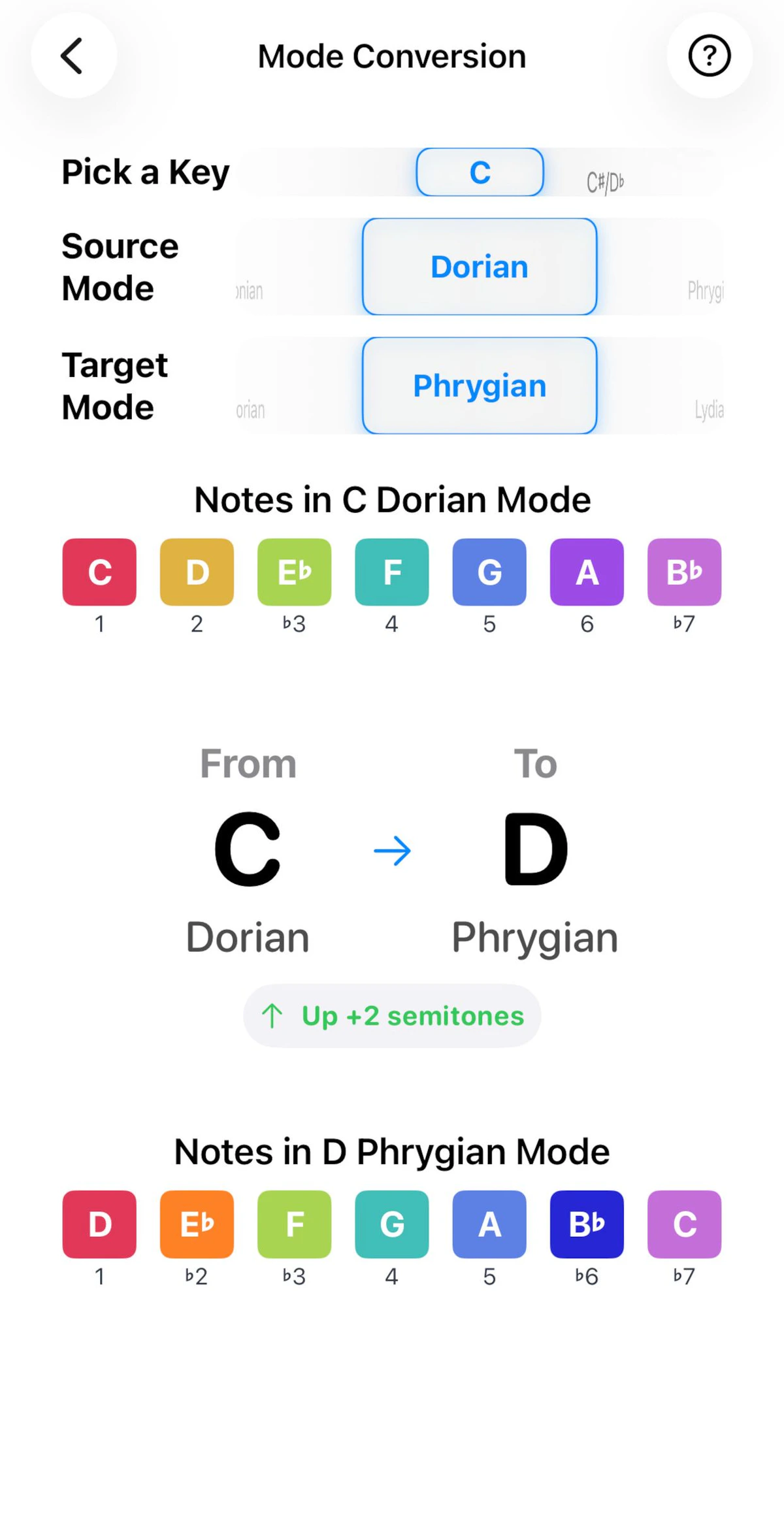
The Mode Converter shows how one mode transforms into another – which notes move, and by how many semitones.
Two ways to think about modes
Relative modes share the same notes but start on a different degree. C Ionian, D Dorian and E Phrygian all use the notes of C major.
Parallel modes share the same root but change the notes. C Ionian, C Dorian and C Mixolydian all start on C – and the converter shows exactly which degrees are raised or lowered. That difference is where each mode’s character comes from.
Quick reference
Each mode compared with the major scale (Ionian), from brightest to darkest. Changed degrees are highlighted.
| Mode | 1 | 2 | 3 | 4 | 5 | 6 | 7 | In C |
|---|---|---|---|---|---|---|---|---|
| Lydian | 1 | 2 | 3 | ♯4 | 5 | 6 | 7 | C D E F♯ G A B |
| Ionian (major) | 1 | 2 | 3 | 4 | 5 | 6 | 7 | C D E F G A B |
| Mixolydian | 1 | 2 | 3 | 4 | 5 | 6 | ♭7 | C D E F G A B♭ |
| Dorian | 1 | 2 | ♭3 | 4 | 5 | 6 | ♭7 | C D E♭ F G A B♭ |
| Aeolian (natural minor) | 1 | 2 | ♭3 | 4 | 5 | ♭6 | ♭7 | C D E♭ F G A♭ B♭ |
| Phrygian | 1 | ♭2 | ♭3 | 4 | 5 | ♭6 | ♭7 | C D♭ E♭ F G A♭ B♭ |
| Locrian | 1 | ♭2 | ♭3 | 4 | ♭5 | ♭6 | ♭7 | C D♭ E♭ F G♭ A♭ B♭ |
Each step down the table lowers one more degree: that’s the “brightness” order.